 |
|
|
Agenda below as delivered!
Updated: Monday February 07, 2011
 Follow
up Technology Forum series beginning in May. First session is on Personal Rapid
Transit (PRT).
Follow
up Technology Forum series beginning in May. First session is on Personal Rapid
Transit (PRT).
Description of PRT from the Conference Notebook can
be downloaded here.
|
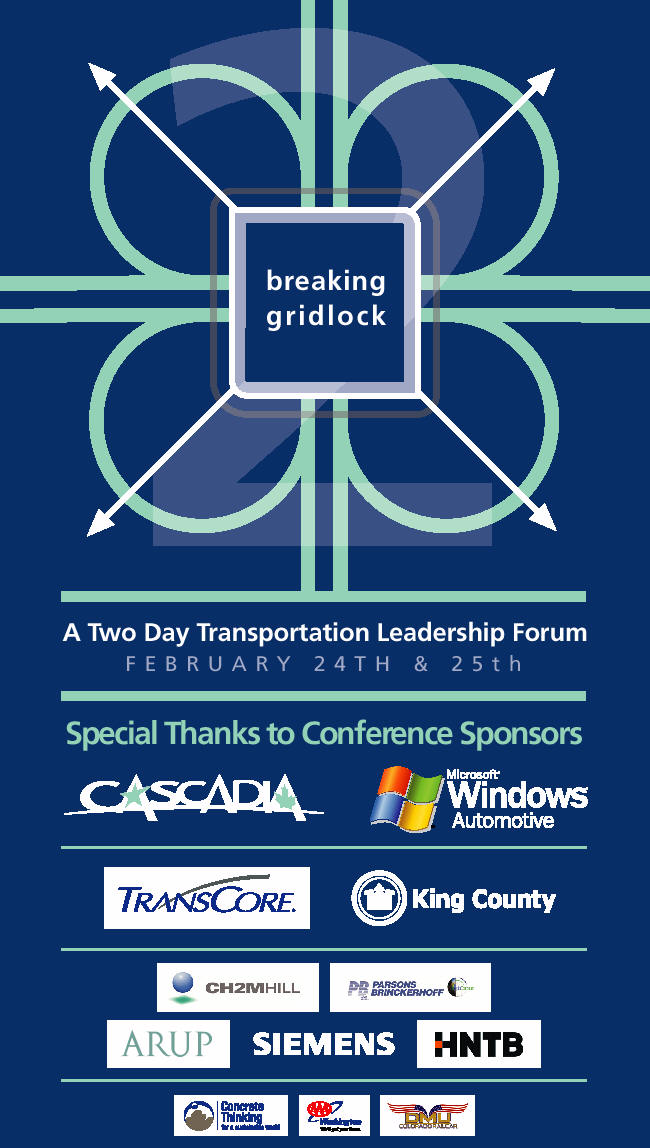
Contact Names and Phone Numbers for Forum Sponsors |
|||
| Cascadia
Center, Discovery Institute Bruce Agnew 206-292-0401 ext. 113 |
Microsoft |
||
| Transcore Dan Toohey 703-288-8572 |
King County,
Washington Ron Posthuma 206-684-1007 |
||
| CH2M Hill Brian Painley 425-453-5000 ext. 5280 |
Parsons
Brinckerhoff Jared Smith 206-382-6347 |
||
| Arup Gary Lawrence 206-749-9674 ext. 228 |
Siemens ITS Alan Clelland 626-294-9255 ext. 9101 |
HNTB Jerry Hautamaki 425-450-2509 |
|
| NW Cement Producers John Arroyo 360-956-7080 |
AAA of
Washington Janet Ray 425-646-2058 |
Colorado Railcar Tom Janaky 303-670-1585 ext. 302 |
|
Technology applications can and do improve the flow of traffic and enhance mobility for people and goods. Selected technologies deliver more bang for the buck ... more performance at less cost. Furthermore, on-going development and deployment of technology applications set the environment within which transportation must work in the years ahead.
 The Cascadia Center of Discovery Institute presented in late February 2005 a hard-hitting, insightful conference to provide new information
and context on technology trends and opportunities for the Cascadia corridor
(Vancouver, BC to Eugene, OR),
with special emphasis on Puget Sound region.
The Cascadia Center of Discovery Institute presented in late February 2005 a hard-hitting, insightful conference to provide new information
and context on technology trends and opportunities for the Cascadia corridor
(Vancouver, BC to Eugene, OR),
with special emphasis on Puget Sound region.
Basic information was provided to participants in a 200 page briefing notebook for all registered participants. Panelists responded to moderator questions with illustrative graphics projected as needed. Moderators asked insightful questions, and encouraged incisive dialog among panelists, with questions taken from audience participants as well.
In the agenda below, click on
 for
visual aids and other information from the Conference in pdf format.
for
visual aids and other information from the Conference in pdf format.
7:30 to 8:30 AM: Registration and deluxe continental breakfast; technology audio/visual wall screens showing technology applications in action
8:30 to 9 AM: Welcoming greetings from Microsoft's Transportation Solutions Executive, Tom O'Neil, and from King County Executive Ron Sims.
9 to 10:15 AM: Technology and Transit: How Can Resources Best Be Allocated? What are the strengths and weaknesses of high-tech buses, light rail, automated guideway transit (monorail, Skytrain, PRT), and Diesel Multiple Unit (DMU) trains? Panel moderator and discussion leader: John Niles, Senior Fellow, Cascadia Center, Discovery Institute.
10:15 to 10:30 AM: Break
10:30 AM-11:45 AM, Panel Two: Value Pricing and Tolling Update: Following up on the November 2003 Conference, Technology, Tolls and Transportation, this panel presents new information from Puget Sound region and around the U.S. on tolling, HOT lanes providing space for Bus Rapid Transit, and area-wide pricing through cordons or ubiquitous in-vehicle metering. Specific projects to be covered with updated information include HOT lanes in California, Minnesota, Virginia, and Washington State, plus cordon pricing in central London, England. Also, the Puget Sound Traffic Choices study of continuous metering of time and location to set a price will be discussed. Key questions: can tolling revenues aimed at managing congestion also be sufficient to fund the construction of new HOT lanes? What about fairness? What about privacy? What about compatibility of vehicle tags in different tolled segments? How much will mobility be improved by this new road management? Panel moderator and discussion leader is King County Councilmember Julia Patterson, Chair, Transportation Policy Board of the Puget Sound Regional Council.
11:45 AM: Catered box lunch, sponsored by Microsoft Corporation
Noon - 1:00 PM: Lunch Keynote: Driving the Future of
Transportation Today:
The Connected Vehicle. Martin Thall,
Automotive Business Unit, Microsoft Corporation -- Describes the computer industry vision for
surface transportation and what the industry hopes to contribute to better
mobility.
1:15 - 2:45 PM: Emerging Technologies: How Big an Impact? A transportation leadership panel from national, state, and local government will respond to technology updates, interspersed with facilitated discussion and questions/comment. Moderated by Bruce Agnew, Director, Cascadia Center of Discovery Institute.
The leadership panel:
Technology specialists make short presentations to elicit comments and questions from the leadership panel. The presentations will be:
(A paper for American Public Transportation Association
)3:00-4:00 PM: Closing Keynote: Exploiting the Third
Dimension...Small Aircraft Transportation and the Airborne Internet.
Pete McHugh, Federal Aviation Administration's Program Manager at the
NASA Small Aircraft Transportation Systems Project
Office describes the ongoing, compelling partnership program of government and
industry to implement more
ubiquitous aviation-based mobility based on small, quiet,
energy-efficient, safe, and fast small airplanes using existing
airports. Introduced by Roei Ganzarski, Director of New Ventures,
Alteon
Training (subsidiary of Boeing).
4:00: Adjourn to hosted reception and networking through 5:30 PM
The Cascadia Center and Microsoft were pleased to host the fourth General Assembly of the West Coast Corridor Coalition, a group of transportation officials from Alaska, Washington, Oregon and California. Members of Congress and/or their staffs were especially invited to participate in this event, scheduled for the Congressional recess..
This assembly focused on freight mobility and the exchange of views on recent developments and opportunities to strengthen the West Coast freight system through new multi-jurisdictional cooperation.
Click on
for visual aids and other information from the Assembly in pdf format.
7:30 to 8:30 AM: Registration and coffee; technology audio/visual wall screens showing technology applications in action (from previous day's technology conference)
8:30 to 9:00 AM: Welcoming greetings from Microsoft Corporation's Transportation Solutions Executive Tom O'Neil, followed by framing remarks on intermodalism and "secure mobility" from Richard Biter, Deputy Director, Office of Intermodalism, Office of the Secretary, US Department of Transportation, Washington, DC. (Mr. Biter discussed the Research and Innovative Technology Administration (RITA) of USDOT)
9:00 AM Report by telephone from Lloyd Jones, Chief of Staff to U.S. Representative Don Young of Alaska
 9:10 to 9:25 AM: West Coast Freight Mobility System -
Overview of the
Gateways, Corridors, and Nodes from Glenn Pascall, Coordinator,
West Coast Corridor Coalition, including his quarterly report on WCCC progress.
9:10 to 9:25 AM: West Coast Freight Mobility System -
Overview of the
Gateways, Corridors, and Nodes from Glenn Pascall, Coordinator,
West Coast Corridor Coalition, including his quarterly report on WCCC progress.
9:25 to 9:30 AM: Comments from Washington State Secretary of Transportation Doug MacDonald
9:30 to 10:15 AM: Gateways Panel of Port Directors, Border Regional Transportation Planning Officials, and Railroad Officials
Questions for the Gateway Panel:
 Listen to TVW audio
recording of 8:30 AM through 10:15 AM:
Listen to TVW audio
recording of 8:30 AM through 10:15 AM:
 Windows Media Player
 Real Player
10:15 to 10:30 AM: Break
10:30 to 11:15 AM: Corridors Panel of State DOT and Trucking Officials
Questions for the Corridors Panel:
Listen
to TVW audio recording of 10:30
AM through 11:15 AM:
Windows Media Player
Real Player
11:15 AM to Noon: Nodes Panel of Metropolitan Planning Organization Officials
Questions for the Nodes Panel:
Listen
to TVW audio recording of 11:15
AM through Noon:
Windows Media Player
Real Player
Noon: Catered box lunch
12:30 PM: Keynote Speech by Congressman Rick Larsen (Washington, 2nd District)
1:00 PM: Greetings to the Assembly
1:15 PM Break
1:30 to 2:45 PM: West Coast Corridor Coalition Participants' Sessions
2:45 to 3:30 PM: Caucus reports and wrap up
3:30 PM: Adjourn

Questions or comments?
Contact the Agenda Coordinator
John Niles, Senior Fellow
Cascadia Center, Discovery Institute
1511 Third Ave., Suite 808
Seattle, WA 98101
206-781-4475
email: niles@discovery.org